If your driveway is cracked, rough, or starting to sink, the real question is not whether it looks bad — it is whether the damage is still fixable. Some pavement problems can be handled with targeted repairs. Others point to deeper base failure and a full replacement. For a residential driveway, the condition of the base matters more than the age alone. In this guide, you’ll learn how to tell the difference, what warning signs matter most, and how to think through the choice without guessing. By the end, you’ll know when a repair buys time, when replacement protects the property, and what to ask before you move forward.
Key Takeaways
If the damage is isolated and the base is still sound, repair is often enough. If you see widespread alligator cracking, sinking, drainage problems, or repeated patch failures, replacement is usually the better long-term fix.
Quick answer
- Repair works best for small, localized surface issues
- Replacement is better for structural failure and recurring damage
- A site visit is the safest way to confirm the right option
- Cracks alone do not tell the full story; the base and drainage matter more.
- Isolated damage can often be repaired, but widespread alligator cracking usually points to replacement.
- Repeated patching is a warning sign that the pavement is failing as a system.
- A contractor should inspect the surface, slope, water flow, and subgrade before recommending a fix.
When asphalt driveway repair makes sense
Repair is the better call when the damage is limited and the structure underneath is still doing its job.
Small cracks and isolated trouble spots
A few narrow cracks, a small pothole, or a single soft area can often be handled without rebuilding the whole driveway. In those cases, a focused repair may be enough to slow further damage and restore a cleaner surface.
If the issue is localized, our driveway repair service is usually the first place to start.
Surface wear without base failure
Fading, minor roughness, and light surface raveling do not always mean the driveway is failing structurally. Those issues can look worse than they are, especially if the base is still stable and water is draining properly.
The key question is whether the problem stays on the surface or keeps coming back after patching.
Repair is usually the right move when:
- cracks are narrow and isolated
- the surface is mostly level
- water is not pooling in multiple areas
- the driveway is otherwise holding up well
- prior repairs have lasted
When replacement is the smarter choice
Replacement becomes the better option when the driveway is failing as a system, not just showing a few bad spots.
Alligator cracking points to structural trouble
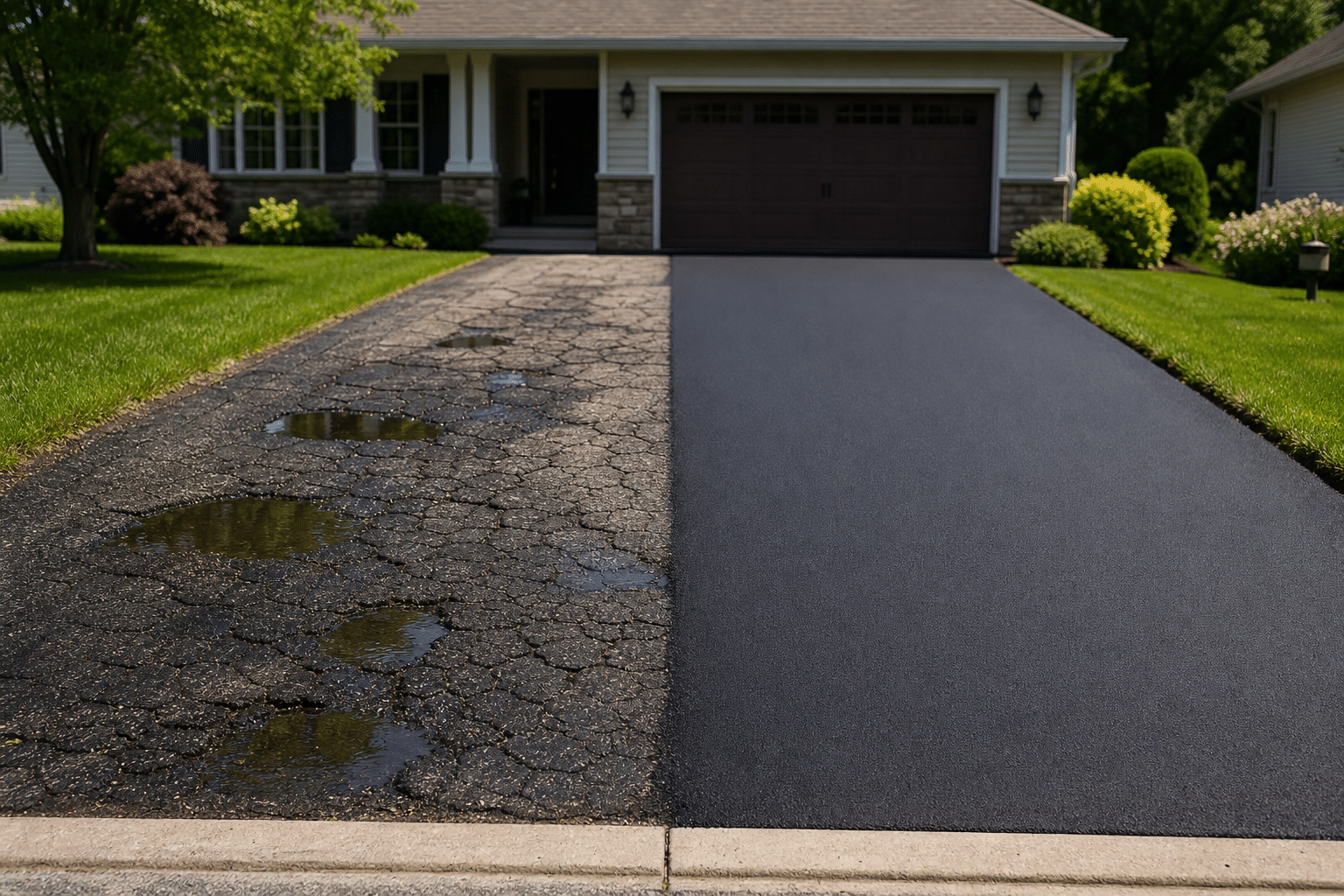
If you see interconnected cracking that looks like a web or fish scales, the base is often compromised. That kind of damage usually means patching will not solve the underlying problem.
That is where new asphalt driveway installation makes more sense than more surface fixes.
Sinking, rutting, and drainage issues
A driveway that dips, holds water, or develops repeated soft spots is telling you the problem goes deeper than the top layer. Drainage and grade problems can keep feeding damage back into the pavement.
Replacement is usually the better move when:
- alligator cracking is widespread
- potholes keep returning
- the driveway has settled or sunk in spots
- drainage problems keep coming back
- repairs are no longer lasting
- large areas are breaking down at once

A simple way to decide
Step 1: Look at how widespread the damage is
If the problem covers one corner, one edge, or one isolated section, repair may be enough. If the damage is scattered across the driveway, the odds of replacement go up fast.
Step 2: Ask whether the base is still sound
The base is the part you do not see, but it controls most of the driveway’s life. If the base is weak, no surface patch will hold up for long.
Step 3: Think about how often you’ve already fixed it
If you are patching the same area over and over, the driveway may be telling you it has reached the end of its useful life.
Step 4: Compare short-term savings with long-term value
Repair costs less up front. Replacement costs more now, but it can reset the whole system and save you from chasing the same problems year after year.
If you want a clear recommendation, request an estimate and have the site looked at before you spend money twice.
What can make repair look cheaper than it is
A repair quote can look appealing when you only compare the number on the estimate. But if the driveway keeps failing, the same area may need to be reopened, patched again, or monitored after every storm. That can make a lower upfront price less attractive over time.
Replacement costs more because it does more work: it removes failed material, resets the structure, and gives the contractor a chance to correct drainage and base issues together. If the driveway is still young and mostly intact, repair usually wins. If the pavement is old and the failures are spreading, replacement tends to be the better value.
What repair can actually involve
Not every repair is the same. The right fix depends on how far the damage has spread and what caused it in the first place.
Crack filling and sealing
For narrow cracks, filling helps keep water out and slow further damage. This is useful when the asphalt is still structurally sound.
Patching isolated failures
If one section has broken down, a patch can remove the failed material and restore that area without disturbing the rest of the driveway.
Resurfacing worn pavement
When the surface is worn but the base is still stable, resurfacing can give the driveway a fresh riding surface without a full rebuild.
Partial or full replacement
If the damage is tied to base failure, soft spots, or repeated settlement, repair stops being cost-effective. At that point, replacement is the cleaner long-term fix.
What a contractor should inspect on site
A good contractor is not just looking at the surface. They should check the whole performance picture.
1. Cracking pattern
Linear cracks, edge cracks, and alligator cracking all mean different things. The pattern helps show whether the issue is cosmetic or structural.
2. Drainage and slope
Standing water is a warning sign. If water cannot leave the surface, the driveway will keep breaking down faster than it should.
3. Base condition
Soft subgrade, settling, and repeated failures usually mean the foundation needs attention before any new asphalt goes down.
4. Age and maintenance history
A well-maintained driveway can last much longer than a neglected one. Age matters, but only when you combine it with the condition of the base and surface.
For a broader look at how preservation works, the Asphalt Institute’s engineering FAQs reinforce that good construction practices and compaction are central to pavement performance: Asphalt Institute technical FAQs.
Repair vs replacement in real life
If the problem is cosmetic
You may be able to repair the surface and keep the driveway in service.
If the problem is structural
Replacement is usually the safer investment because it addresses the base, drainage, and surface together.
If you are somewhere in the middle
A contractor can sometimes recommend a partial repair, but only if the damaged area is truly isolated.
A city pavement preservation program makes the same point: treatments work best before cracking becomes extensive, which is why timing matters so much: Pavement Preservation Program.
What not to do when you are trying to decide
Do not keep sealing over structural failures and hope they disappear. Sealcoat helps protect the surface, but it does not rebuild a weak base.
Do not judge the driveway by appearance alone, either. A surface that looks rough may still be repairable, while a surface that looks okay on top can hide deeper problems underneath.
Do not wait until the driveway is breaking apart in multiple places. The earlier you get an evaluation, the more options you usually have.
FAQs
Is resurfacing the same as repair?
Not exactly. Resurfacing adds a new layer over the existing pavement, while repair usually means fixing a specific damaged area. Which one makes sense depends on the driveway’s overall condition.
How do I know if cracks are bad enough to replace the driveway?
If the cracks are widespread, connected, or tied to sinking and water issues, replacement is more likely than repair.
Can a bad-looking driveway still be repairable?
Yes. Some driveways look rough but still have a solid structure underneath. A site visit is the best way to tell.
Should I keep patching a driveway that keeps failing?
Usually not. Repeated patching can turn into a short-term habit that costs more than rebuilding the driveway the right way.
What should I ask before I decide?
Ask whether the problem is surface-level or structural, whether the base is sound, and whether repair will last long enough to be worth the cost.
Choose the fix that protects the whole driveway
The best choice is not the cheapest one today — it is the one that keeps the driveway from failing again next season. If you want help deciding whether repair or replacement is the right move, reach out to Maisano Brothers Inc. and request an estimate before the damage spreads.
Image credits: featured image and in-body image generated with OpenAI.